Premium Subscription

DESIGNING A SUBSCRIPTION AROUND REAL CUSTOMER ADVANTAGE
I helped transform an ad-free subscription into a differentiated marketplace product, then extended the underlying model into a flexible pay-to-post experience for high-intent categories such as Autos.
OVERVIEW
OfferUp needed to grow revenue without weakening the marketplace experience. Customers already complained about advertising, which made an ad-free subscription a logical starting point—but removing a frustration alone was not enough to create a durable product.
We needed to understand what frequent buyers and sellers would value every month, how to communicate that value, and how the subscription model could support more than one business opportunity.
Working closely with my product manager and cross-functional partners, I led research, flows, prototyping, and the visual direction for a subscription built around practical marketplace advantages. We tested value propositions incrementally, improved the path to trial, and explored how the same monetization framework could support pay-to-post offerings in Autos and other categories.
[IMAGE BREAK — NEED TO OFFER TO CUSTOMER OUTCOME]
THE CHALLENGE
The business needed recurring revenue. Customers needed a reason to care.
An ad-free experience addressed a clear complaint, but it did not fully answer the customer’s question: What will Premium help me do that I cannot do today?
The product needed to create value for both sides of the marketplace:
• Help buyers find desirable inventory sooner
• Help serious customers signal trust
• Help sellers gain more visibility and engagement
• Reduce friction for frequent marketplace users
• Create a recurring revenue stream for the business
At the same time, the team needed to learn which benefits, bundles, trials, and price presentations customers would understand and choose.
[IMAGE BREAK — BUSINESS AND CUSTOMER VALUE]
MY ROLE
I collaborated with the product manager on strategy and prioritization, owned customer, subscription, and price-perception research, and designed the subscription, trial, and benefit flows.
I built working prototypes for research and experimentation, led the visual direction for Premium branding, iconography, and badging, and supervised and partnered with visual design. Experiment design was collaborative across product, engineering, data, marketing, and research. After launch, I reviewed results and customer behavior with the product manager.
FORMAL RESEARCH MET LIVED MARKETPLACE BEHAVIOR
I combined reviews, customer interviews, subscription research, concept evaluation, and pricing-oriented research with direct experience as an OfferUp customer.
I regularly bought and sold on the marketplace. At times, I went to estate sales specifically to source items and understand the experience of resellers. During transactions, I told buyers and sellers that I worked at OfferUp and asked about the problems they encountered.
A recurring insight was that speed created real value. Customers believed the best way to get a desirable item was to be the first person to see it and make an offer. That insight became Early Access.
Other research revealed the importance of credibility. The Premium badge became more than decoration. It signaled that a buyer or seller was serious and invested in the marketplace—similar to verification, but connected to additional product benefits.
[IMAGE BREAK — CUSTOMER INSIGHTS TO EARLY ACCESS AND BADGING]
EVALUATING A PORTFOLIO OF BENEFITS
The research considered benefits including:
• Ad-free browsing
• Premium identity and profile badging
• Early Access to eligible new listings
• Priority positioning in conversations
• Listing promotions
• Increased listing visibility in the feed
• Exclusive pricing or transaction benefits
The goal was not to maximize the length of a benefits list. It was to determine which combination created a subscription customers could quickly understand and believe would improve their outcomes.
[IMAGE BREAK — PREMIUM BENEFIT PORTFOLIO]
BUILDING VALUE PROGRESSIVELY
We added and tested the primary value propositions incrementally:
1. Ad-free browsing and Premium badging established a cleaner experience and trusted identity.
2. Early Access gave buyers and resellers a meaningful competitive advantage.
3. Promotions let sellers move an item higher in the feed and attract more attention.
4. Feed ranking gave Premium listings greater visibility across the marketplace.
Each addition produced a meaningful increase in signups. The pattern showed that conversion improved as the subscription evolved from simply removing friction to helping customers achieve better marketplace outcomes.
[IMAGE BREAK — VALUE-PROPOSITION TESTING SEQUENCE]
MAKING THE VALUE EASY TO IMAGINE
The customer journey exposed a critical conversion question: Could someone quickly imagine Premium improving their own experience?
We used clear benefits, recognizable in-product examples, a low-friction free trial, and contextual entry points to shorten that mental calculation. Customers did not have to understand an abstract membership program. They could picture seeing an item sooner, getting a response, appearing more credible, or selling faster.
[IMAGE BREAK — CONTEXTUAL TRIGGER TO TRIAL TO BENEFIT IN USE]
EXPLORING PACKAGING AND PRICE PERCEPTION
We studied how customers responded to different benefit combinations, subscription tiers, trial framing, and price presentation. Concepts included tiered good, better, and best structures as well as a focused Premium offer.
My role was to lead the customer and subscription research and translate it into product structure and design. Pricing and experiment decisions were made collaboratively with the product manager and cross-functional team.
[IMAGE BREAK — SUBSCRIPTION-TIER AND PACKAGING EXPLORATIONS]
PROGRAM IMPACT
The broader Premium program produced substantial gains as the team improved the value proposition, free-trial experience, and contextual paths into the subscription.
The important signal was consistent: customers responded when Premium offered practical advantages tied to real marketplace behavior. Each incrementally tested benefit helped the team learn what customers valued and strengthened the overall offer.
[IMAGE BREAK — PREMIUM PROGRAM IMPACT]
EXTENDING THE MODEL TO PAY TO POST
Premium demonstrated that OfferUp could create recurring revenue by connecting payment to meaningful marketplace value. The next question was whether the same subscription and purchase framework could support additional verticals.
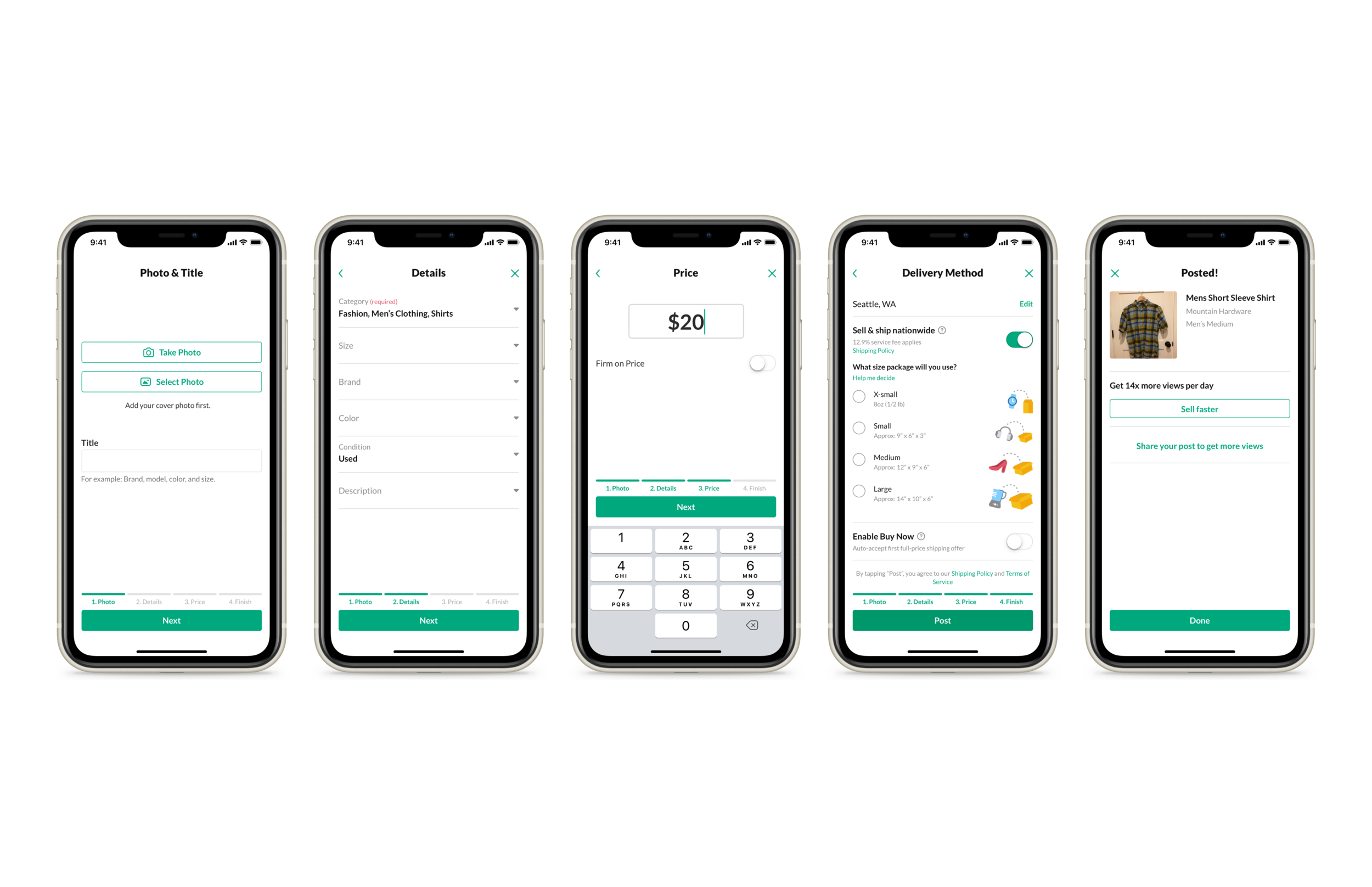
Autos became an important test category. When a customer exhausted the free posting allowance for Cars & Trucks, the experience presented several paths:
• Wait until the free allowance reset
• Purchase one additional post
• Subscribe to a recurring bundle of posts
• Join the dealer program when the customer’s needs were professional
We explored multiple package structures, including single purchases and monthly bundles. The designs tested different quantities, price-per-post versus total price, recommendation labels, comparison layouts, subscription-first framing, and a pathway for dealers whose needs exceeded the consumer offer.
This was more than an Autos paywall. It showed that the underlying monetization model could flex around category rules, entitlements, purchase frequency, and customer type.
[IMAGE BREAK — AUTOS TRIGGER AND PURCHASE OPTIONS]
DESIGNING FOR REUSE ACROSS VERTICALS
When I left OfferUp, the team was beginning to prepare tests across Autos, Furniture, Boats, and other categories.
The system was designed around configurable inputs:
• Category rules
• Free posting allowances
• One-time or recurring purchase types
• Bundle quantities
• Price presentation
• Recommendation labels
• Professional or dealer pathways
The framework could create different offers without requiring every category to invent a new monetization experience.
[IMAGE BREAK — REUSABLE MONETIZATION MODEL ACROSS CATEGORIES]
OUTCOME
The work turned Premium from a narrow ad-removal proposition into a growing marketplace product with practical buyer and seller advantages. It also established the product thinking and interaction patterns needed to explore recurring and transactional monetization across additional categories.
The larger contribution was a reusable decision framework: connect payment to a clear customer outcome, introduce it at a moment of demonstrated need, offer choices without obscuring the primary recommendation, and preserve an appropriate path for customers who do not fit the subscription.
[IMAGE BREAK — DEMONSTRATED NEED TO MEANINGFUL OUTCOME TO GUIDED CHOICE]
WHAT THIS DEMONSTRATES
• Customer-led product strategy
• Subscription and marketplace monetization design
• Research ownership and experimentation
• Packaging, price-perception, and choice architecture
• Prototyping complex purchase flows
• Collaboration across product, engineering, data, marketing, and research
• Designing a system that could extend across multiple verticals