OfferUp Post Flow Design
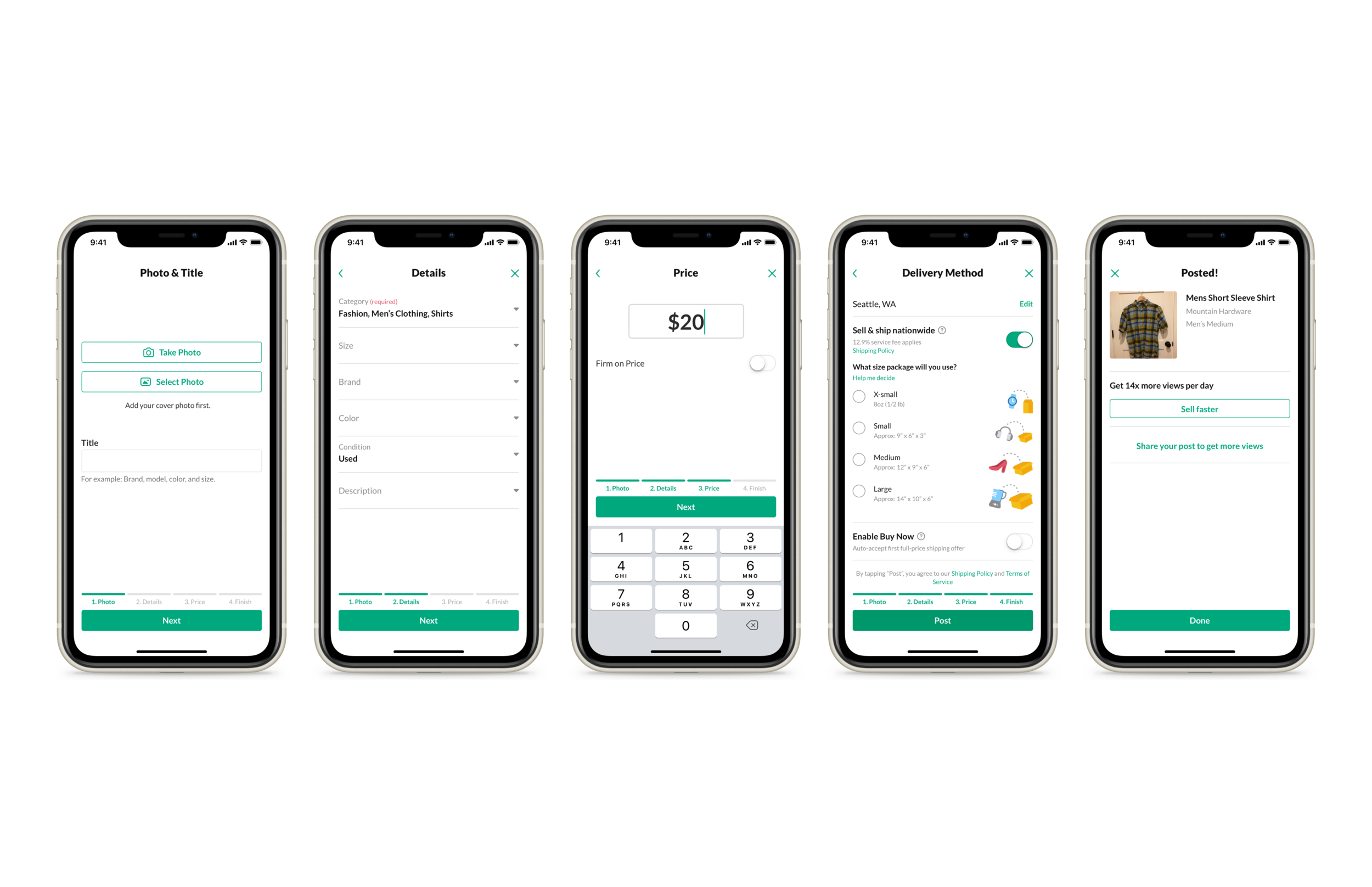
Redesigning the Flow That Creates the Marketplace
I helped redesign OfferUp’s company-wide posting system so customers could create richer, better-categorized listings without sacrificing completion—while giving the business a flexible foundation for category-specific growth.
In a marketplace, inventory is the starting point for everything else. If sellers cannot post successfully, buyers have nothing to discover. But a completed post is not enough: listings with accurate categories and richer information are easier to understand, easier to find, and more likely to sell.
OfferUp’s existing Post Flow was too rigid to support the needs of a rapidly scaling marketplace. The company was introducing a deeper category taxonomy, expanding category-specific business models, and trying to collect more useful item metadata. At the same time, every added decision or field risked causing sellers to abandon their posts.
I worked across product, research, data science, engineering, and category teams to redesign Post Flow as a shared system with category-specific intelligence. We connected title-based category prediction to an interaction model customers could understand, used Autos as a proving ground for structured data, and refactored the underlying flow so the team could evolve it incrementally.
The redesigned experience launched across the marketplace. Despite adding a new taxonomy and more opportunities to provide metadata, posting completion increased by approximately 2–3 percentage points, with no additional step-level drop-off attributable to the new structure.
The problem
The business needed better inventory without putting inventory at risk
The goals pulled in opposite directions:
The business needed richer category-specific data to improve discovery, item detail, and monetization.
Professional sellers and high-value verticals needed workflows that supported more complex inventory.
A new multi-tier taxonomy needed to work across every top-level category.
The data model could predict some category levels more reliably than others.
Every new field or decision increased the possibility of posting abandonment.
The marketplace could not afford to reduce supply. At OfferUp, inventory was king.
This was not simply a question of how to arrange form fields. It was a system-design problem spanning customer mental models, machine-learning capability, taxonomy, data architecture, interface behavior, and marketplace economics.
IMAGE PLACEHOLDER — THE SYSTEM TENSION
Customer language, prediction and taxonomy, category metadata, and marketplace supply—with Post Flow at the center.
The design question
How might we collect the category and item information the marketplace needed while helping sellers post more easily—and without reducing the creation of inventory?
My role
I was the product designer for this work. Over approximately one year, including testing, I contributed across the full design process:
Helped shape product strategy with my product manager, Balaji
Led and partnered on customer research with my research partner
Designed the end-to-end flow architecture, interactions, and visual experience
Reviewed the evolving taxonomy against customer mental models
Worked closely with data science on category-prediction behavior and fallback states
Defined category-specific metadata patterns, including Autos’ structured vehicle flow
Built working prototypes and led usability testing across top-tier categories
Partnered tightly with Sam, the frontend-focused full-stack engineer, the backend engineer, and the broader engineering team
Broke a company-wide initiative into smaller vertical-focused working sessions to create decisions between high-stakes executive reviews
Reviewed step-level launch and completion data with product partners
I brought leadership, customer knowledge, and cross-functional collaboration to a program that touched much of the company. The work contributed to my promotion from Product Designer to Senior Product Designer.
IMAGE PLACEHOLDER — SCOPE OF OWNERSHIP
Research → System architecture → Interaction design → Prototyping and testing → Launch learning.
Starting from the bottom up
We developed the taxonomy and the experience together
The team could not design Post Flow after the taxonomy was finished. The taxonomy directly determined the decisions customers would encounter, while usability testing could reveal where the taxonomy failed to reflect how people actually described their items.
We began with cross-functional workshops in parallel with taxonomy development. I reviewed the structure extensively to identify conflicts between the data hierarchy and customer mental models. We then built working prototypes and tested the experience across all top-tier categories.
Research did more than adjust interface copy. When people struggled to find the right place for an item, the problem sometimes lived in the taxonomy itself. Usability findings traveled back upstream and changed the structure.
We also treated required fields conservatively. The business wanted more metadata, but each required response introduced risk. We made many fields optional until there was enough evidence that requiring them would help more than it hurt.
IMAGE PLACEHOLDER — RESEARCH CHANGED THE SYSTEM
Prototype → usability finding → taxonomy or UX change → retest.
Category selection: designing the UX and model as one system
A prediction is only useful if the experience understands its limits
Sellers began by entering the title of the item they wanted to sell. A machine-learning model then predicted its category. The strongest experience would remove category selection almost entirely, but the model could not reliably predict every level of a new, multi-tier hierarchy.
That constraint became a design input rather than something to conceal. I worked closely with data science to align the interaction model with the depth the prediction model could actually support.
Optimal: Tier 2. The model predicts the useful category depth, so the seller can continue without a separate category-selection task.
Fallback: Tier 1. The model has only broad confidence, so the seller receives a short path forward instead of a false sense of precision.
Tier 3: customer selected. The finest level remains optional, adding specificity without creating mandatory drop-off.
The category-selection UI exposed only the decisions customers needed. It let them step backward or forward when the prediction was wrong, and it preserved a way out for edge cases. Ideally, a seller would never have to begin at Tier 1.
IMAGE PLACEHOLDER — PREDICTION STATES
Tier 2 prediction, Tier 1 fallback, and optional Tier 3.
Customer language became part of the interaction
The title gave the model evidence, but the quality of that evidence varied. “Honda” could refer to a car, a lawn mower, or something else. “Honda Accord” was specific enough to identify the product family and enter the vehicle-attribute flow.
That meant the Post Flow could guide customers toward clearer listing language while also using the title to reduce work. In Autos, the structured sequence helped sellers create better titles and better data at the same time.
IMAGE PLACEHOLDER — FROM LANGUAGE TO PREDICTION
“Honda” as an ambiguous input beside “Honda Accord” as a confident path into Autos.
Key principle: Don’t have the UX sell what the data model can’t supply.
Autos as the proving ground
The marketplace’s most demanding vertical made the system real
Autos was OfferUp’s largest vertical outside advertising and already supported a dealer program. It needed to serve both casual sellers and professional inventory, and vehicle listings required far more structure than a typical marketplace post.
That made Autos an effective proving ground. If the shared Post Flow could support vehicle-specific data without becoming overwhelming or reducing completion, the underlying pattern could extend to other categories.
OfferUp used VinAudit structured vehicle data. To unlock reliable downstream attributes, sellers needed to provide information in a specific order:
Year
Make
Model
After Year, Make, and Model were known, the system could reveal the relevant next options and make additional vehicle details easier to enter. That metadata could then be carried forward into the item-detail experience I had redesigned.
IMAGE PLACEHOLDER — YEAR → MAKE → MODEL
The signature progressive-disclosure sequence, followed by the newly available vehicle attributes.
Metadata connected posting to the rest of the marketplace
The value of structured data did not end when a seller tapped Post. The information could backfill a more useful item-detail page, support better discovery, and give buyers more confidence in what they were considering.
This made metadata a customer-value system rather than a data-collection exercise:
Sellers received a guided path through complex information.
Buyers received clearer, more complete listings.
The marketplace gained structured inventory that could support discovery and category-specific products.
The business gained a reusable foundation for programs such as professional selling and pay to post.
IMAGE PLACEHOLDER — INPUT BECOMES MARKETPLACE VALUE
An Autos metadata screen connected to the redesigned vehicle item-detail page.
Building a flexible foundation without taking reckless risk
Refactor the system; evolve the experience incrementally
The existing flow had to support a new taxonomy and category-specific behavior, so the engineering team needed to refactor it. We used that investment to create enough flexibility to explore larger experience changes—including a possible single-step Post Flow—while preserving the stepped flow customers already understood.
The single-step concept was ultimately considered too risky to launch. OfferUp faced the classic marketplace chicken-and-egg problem, and the company chose to protect supply. The foundation could support experimentation, but capability alone did not justify exposing the marketplace to unnecessary posting risk.
IMAGE PLACEHOLDER — ARCHITECTURE FOR OPTIONS
Shared Post Flow foundation supporting the launched stepped flow and an exploration-only single-step concept.
Some valuable ideas were rejected for trust reasons
The team wanted to let customers post on the web, especially for Autos and professional sellers. But web posting would also make it easier for bots to create fraudulent inventory. The opportunity was real; so was the trust-and-safety risk.
We did not launch web posting. This was another example of designing for the health of the marketplace rather than treating feature breadth as the goal.
IMAGE PLACEHOLDER — A DELIBERATE TRADEOFF
Web posting, automation and fraud exposure, and the decision to retain mobile-first posting.
Leading alignment across the company
One launch required many vertical decisions
Because the new taxonomy applied to the entire marketplace, the team could not release one category at a time. Every category had to use the new system, even though each had different metadata needs and business priorities.
The work drew intense attention. Large executive and stakeholder reviews included COO Bill Carr and created a forcing function for alignment. Between those sessions, I broke the program into smaller, focused meetings by vertical so teams could solve concrete decisions and return with progress instead of debating the entire marketplace at once.
That operating rhythm helped a broad group work as one system:
Balaji and I maintained a close product-and-design partnership.
Research grounded the taxonomy and interaction decisions in customer behavior.
Data science defined what prediction could reliably support.
Sam, the frontend-focused full-stack engineer, and the backend engineer helped turn the interaction model into a flexible product foundation.
Category and business teams brought the constraints of their verticals.
Executive reviews kept company-level decisions visible and accountable.
The collaboration with Sam continued beyond OfferUp; he later hired me as a consultant at his company.
IMAGE PLACEHOLDER — BOTTOM-UP WORK, COMPANY-WIDE ALIGNMENT
Focused vertical working sessions feeding a shared company-wide review.
Launch and outcome
We added structure without adding drop-off
We instrumented each step and reviewed where sellers abandoned the flow. The redesign introduced a new taxonomy, prediction behavior, and more opportunities to provide metadata—yet it did not create the feared decline in marketplace supply.
Post Flow completion increased by approximately 2–3 percentage points. In a mature, high-volume marketplace flow, that was a meaningful improvement.
The new taxonomy and metadata experience introduced no additional step-level drop-off.
The category-selection model and UX were a key success, although the new taxonomy created a new baseline that made a direct pre/post prediction comparison difficult.
Metadata completion improved, with stronger effects in categories that used pay to post; the exact overall lift is no longer available.
Listings with more information showed better sell rates, including vehicle listings.
Richer inputs enabled better item-detail experiences and a more reusable foundation across categories.
The structured experience appeared to reduce effort and time to post, but time to post was not formally tracked and should not be presented as a quantified result.
IMAGE PLACEHOLDER — OUTCOME
+2–3 points in Post Flow completion, no added step-level drop-off, and richer listings showing better sell rates.
What I learned
Design the promise and the capability together
The most important lesson was not about a component or a field. It was about product truth.
Don’t have the UX sell what the data model can’t supply.
The model, taxonomy, interface, and fallback behavior had to be designed together. If the prediction was uncertain, the experience needed to acknowledge that uncertainty and help the customer recover. If the system required structured information, the interaction needed to request it in an order that made sense. If richer data threatened completion, we needed to be conservative about what was required.
The work also reinforced three broader principles:
Research can change the system, not just the screen. Usability findings helped reshape the taxonomy itself.
A platform investment creates options; it does not remove judgment. We enabled exploration of a single-step flow but chose not to risk marketplace supply.
Alignment scales through focused decisions. Smaller vertical sessions made high-stakes company-wide reviews productive.
IMAGE PLACEHOLDER — CLOSING SYNTHESIS
The title, category prediction, and Year / Make / Model screens with the labels Customer mental model, System capability, and Marketplace health.
What this demonstrates
End-to-end product and systems design in a high-volume marketplace
The ability to translate machine-learning limitations into honest, resilient UX
Research leadership that influenced taxonomy and product structure
Cross-functional leadership across product, data science, research, engineering, vertical teams, and executives
Structured-data and progressive-disclosure design for complex domains
Pragmatic decision-making that balanced innovation with supply, completion, fraud, and trust
Platform thinking: one shared foundation with reusable category-specific behavior
Measurable improvement to a mission-critical product flow